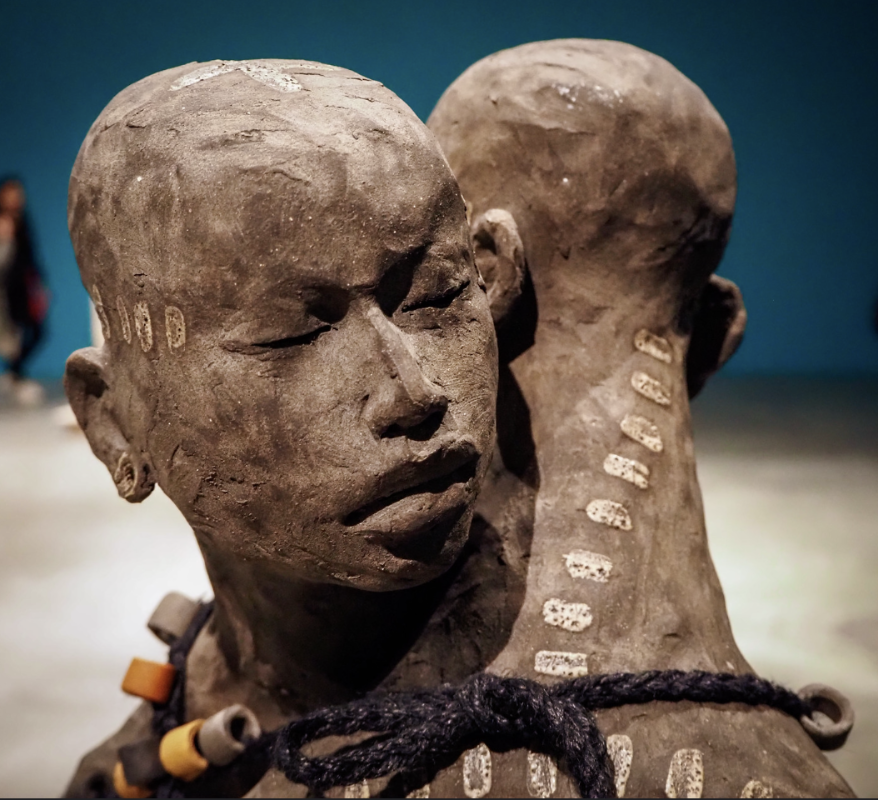
Location
Santa Fe, New Mexico, 87505
About this event
IT SEEMS EVERYWHERE THERE ARE EYES
Rose B. Simpson and Joshua Michael Schrei on Animacy and the Life of Objects
Wednesday, October 7, 6 - 8 PM
ICA Santa Fe
Across most of human history, we encountered a world imbued with aliveness. Our ancestors saw a reciprocal gaze shining back from stones, trees, tools, vessels, and the land itself. The notion that objects are inanimate and inert has arisen only in the last 0.1 percent of human history.
Join sculptor Rose B. Simpson and Joshua Michael Schrei, creator and host of The Emerald podcast, for a conversation about animacy, artistic practice, and our relationships with the materials and objects that surround us.
Simpson and Schrei will consider what becomes possible when we encounter artworks, and the world itself, not as a collection of passive objects, but begin to re-member our relationship with what has been rendered static and recognize a world in which everything has eyes. Drawing from Simpson’s relationship with clay and her deep engagement with artistic practice, and Schrei’s work with myth, story, and animate traditions, the conversation will explore making as an exchange between artist and material, and the ways objects can carry intention, memory, agency, and power.
The event grows from a conversation between Simpson and Schrei that helped inspire the Emerald episode Inanimate Objects Aren’t Inanimate (Or Objects).
Rose B. Simpson is a mixed-media artist from Santa Clara Pueblo, New Mexico. Working across ceramic sculpture, metal, fashion, performance, music, and installation, she creates figures and objects that explore relationship, transformation, ancestry, and the complex work of being human.
Joshua Michael Schrei is the creator and host of The Emerald, a podcast that draws from mythology, ecology, music, and story to examine the animate and imaginative dimensions of human experience. His work asks how older relational ways of encountering the world might speak to the fractures and crises of contemporary life.