-
Wed, Sep 30 12:00 PM
Timed Ticket Entries -
Wed, Sep 30 01:00 PM
Timed Ticket Entries -
Wed, Sep 30 02:00 PM
Timed Ticket Entries -
Wed, Sep 30 03:00 PM
Timed Ticket Entries -
Wed, Sep 30 04:00 PM
Timed Ticket Entries - See more events
About this event
Carol Willis, museum director and curator of the exhibition The Invention of Park Avenue, will launch the related series with an online lecture TRA(I)NSFORMATION. The talk will illustrate how the New York Central Railroad transformed its right of way into Manhattan via Fourth Avenue into a spectacularly successful infrastructure project that linked rail and real estate, not only as a revenue stream, but as what became an engine of urban development.
Previewing the arc of the series, Willis will illustrate how, in its first phase, Park Avenue was a zone of posh hotels, clubs, and apartments. The "highest and best use" began to shift toward tall office buildings in the mid-1920s. In the postwar years, a boom in speculative office towers answered growing demand for modern, air-conditioned space. Soon, the iconic Lever House, Seagram, and Union Carbide buildings recast Park Avenue as an elite corporate corridor. In the 21st century, incentivized by the City’s rezoning of East Midtown, new skyscrapers of even greater height and density have continued to redefine its trophy architecture and secure the future of the Midtown's prestige address.
Carol Willis
Carol Willis is the founder, director, and curator of The Skyscraper Museum. She is the author of Form Follows Finance: Skyscrapers and Skylines in New York and Chicago (Princeton Architectural Press, 1995), among other publications. An architectural and urban historian, she has taught as an adjunct professor at Columbia University for more than thirty years.
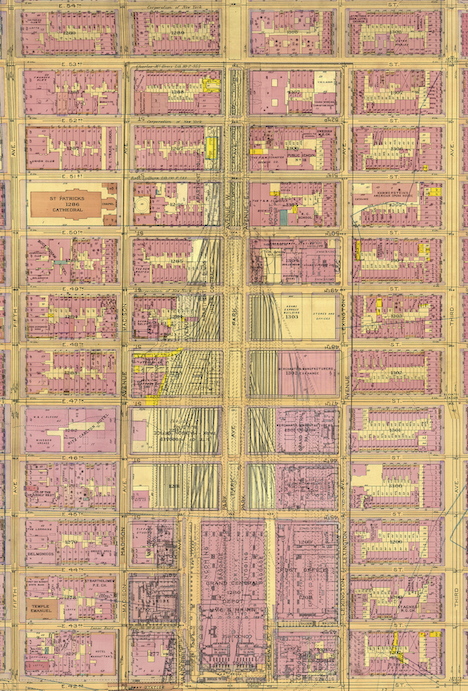
Image: 1915 Bromley Fire Insurance Map, overlaid on a diagram and map of Grand Central’s new track system from “Grand Central Development Seen as Great Civic Center,” Engineering News-Record 85, no. 11 (1920): 496-504.