Location
Santa Fe, New Mexico, 87505
-
Mon, Sep 28 06:00 PM
UNTANGLING CULTURAL APPROPRIATION Indigenous Art, Law, and Collective Ownership -
Wed, Oct 07 06:00 PM
IT SEEMS EVERYWHERE THERE ARE EYES Rose B. Simpson and Joshua Michael Schrei
About this event
Presented by the Institute of Contemporary Art, Santa Fe
Led by Chiara Giovando and Forest Graham, with special guest speakers
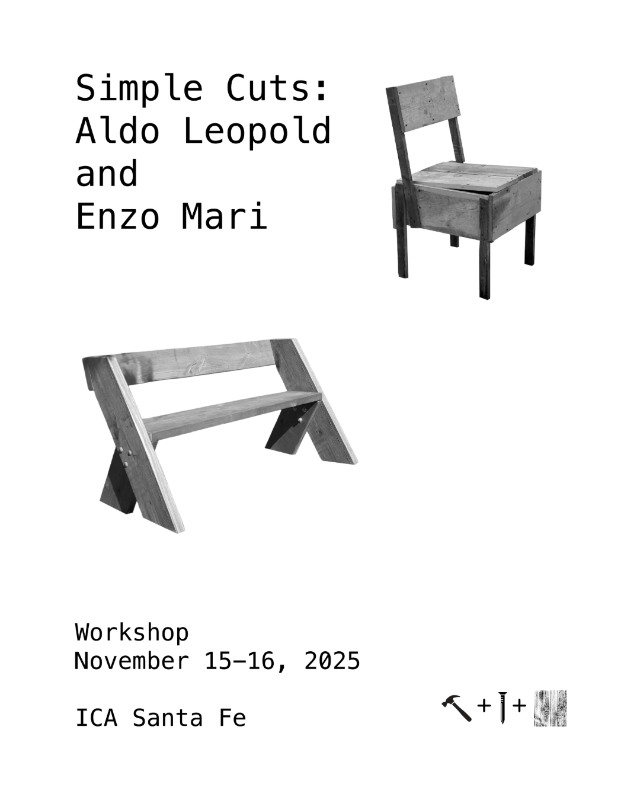
Simple Cuts brings together art, ecology, and design through a two-day woodworking workshop and public program. Participants will explore the philosophies of Aldo Leopold and Enzo Mari—two figures who, in different eras and contexts, used simplicity as both a critique of industrial excess and a practice of attentive observation toward the living world.
Workshop
Saturday, November 15 (10 AM – 4 PM)
Sunday, November 16 (11 AM – 4 PM)
Tuition: $250 — includes all materials, tools, and instruction
Scribe the rough-sawn, fresh off the mill. Plunge cut, rip cut, true cut — the sawyer’s language names each move of the blade, each bite into the board. From these simple cuts comes the bench, the chair, the table, the shelf — the objects upon which our lives are set.
Over two days, participants will receive step-by-step instruction and theoretical discussion led by Chiara Giovando and Forest Graham. Each student will complete and take home either an Aldo Leopold bench or an Enzo Mari chair, built from specially milled New Mexico wood, finished with natural wax, and informed by conversation on design, ecology, and ethics in practice.
Simple Cuts examines the furniture designs of Aldo Leopold, the American ecologist and philosopher whose work helped establish the Pecos as the first designated wilderness in the United States, and Enzo Mari, the Italian designer and theorist celebrated for his uncompromising vision of design as a social and political act. Both embraced simplicity not just as an aesthetic choice, but as an ideological position. Alongside their work, the project brings in local voices from lumber, forestry, conservation, and design to open a critical conversation about the total path a piece of furniture takes — how something as humble as a wooden chair connects to complex politics of land, labor, and use.